A T-shirt collar can look crisp on day one, then develop a wavy, “bacon” edge after repeated wear. The problem is rarely caused by one factor alone. Rib-knit structure, yarn twist, fiber recovery, seam tension, heat, and washing habits can all contribute. The exact question is: why do t shirt collars bacon and stretch out?
The answer begins with the collar’s engineering. A neck rib must stretch over the head, then recover closely around the neckline. If the rib has weak elastic recovery, it may remain wider after use. Poorly balanced stitching can also pull the neckline into ripples. Cotton-heavy fabrics may soften and relax, while elastane can lose recovery after heat, detergent exposure, or repeated drying. It is a small component under constant stress.
Industry data gives this issue wider relevance. Textile Exchange’s Materials Market Report 2024 estimates global fiber production reached about 124 million tonnes in 2023 and may approach 160 million tonnes by 2030. More garments make durability and product life harder to ignore. The Ellen MacArthur Foundation’s clothing research also emphasizes designing products for longer use, not merely faster replacement. A stretched collar is a simple, visible failure of that principle.
AATCC laundering methods and ASTM textile-testing practices help brands measure dimensional change, appearance, and recovery more consistently. Still, laboratory performance cannot fully recreate a person’s wardrobe. Some conclusions remain imperfect. Washing temperature, hanger storage, body oils, and even how a shirt is pulled over the head can change results. This guide examines the materials, construction choices, care conditions, and quality checks behind collar distortion in 2026.
What “Baconing” Means in a T-Shirt Collar
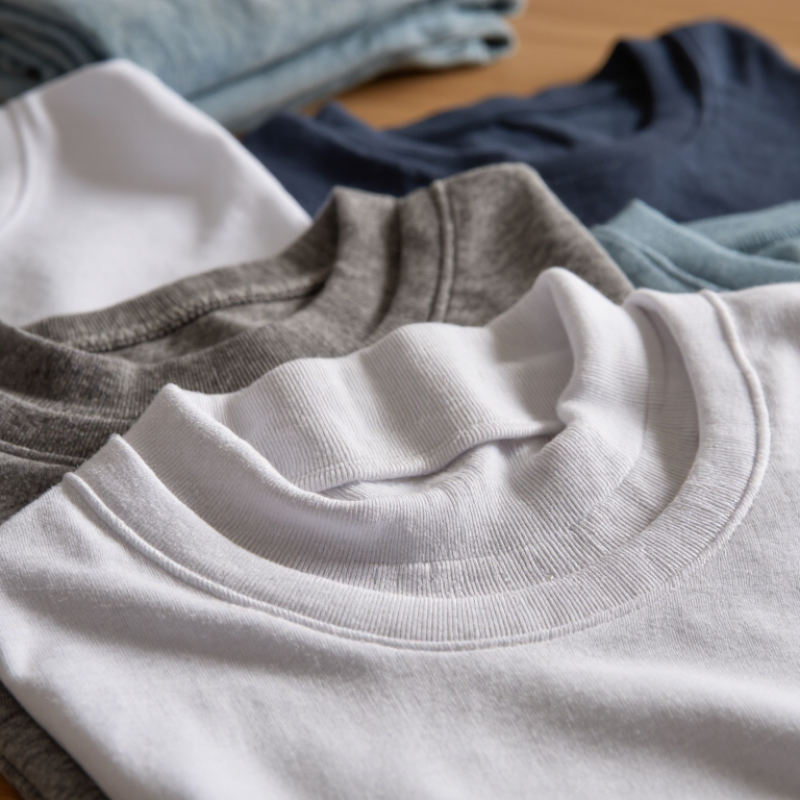
In a T-shirt, “baconing” describes a collar that no longer lies flat. Its edge develops soft waves, bumps, or ripples, much like the uneven edge of cooked bacon. The shirt may still fit through the body, but the neckline looks stretched or floppy. It’s a visual description, not a formal fabric defect.
A close look can help distinguish baconing from a collar that is simply wide. Lay the shirt flat and check whether the ribbed band curls or rises in irregular sections. The waves often appear after repeated pulling over the head, rough washing, or exposure to high dryer heat. A collar’s shape also depends on its ribbing, stitching, and how well the fabric springs back. Small details matter.
Not every wavy collar has one clear cause. I may be overreading a ripple that started with a single awkward tug. Still, if the neckline keeps growing and stays uneven after washing, its fibers may have lost some recovery. Avoid yanking the collar when putting the shirt on, and follow the care label’s temperature guidance. A little restraint helps. But once the ribbing has permanently stretched, gentle care may not restore its original shape.
How Fabric Structure Causes Collar Rippling and Stretching
Why Do T Shirt Collars Bacon and Stretch Out in 2026?
A T-shirt collar can develop ripples because of its fabric structure. The neckline usually uses rib knit, which contains loops that stretch and recover. When those loops lose tension, the edge begins to wave like bacon. In 2026, lighter jersey fabrics remain popular because they feel cooler and softer. However, thinner yarns may offer less resistance around the neck. Repeated pulling also weakens the collar faster.
Cotton fibers absorb moisture and swell during washing. Heat then encourages shrinkage in the body while the collar may stay stretched. This mismatch creates visible rippling. Poorly balanced rib width, weak seam stitching, or uneven recovery can make the problem worse. From garment testing experience, collar recovery should be checked after repeated stretch cycles, not only when the shirt is new. I once blamed washing alone. That explanation was incomplete.
Tips: Wash T-shirts in cool water and avoid high-heat drying. Support the collar when removing the shirt. Do not pull from the neckline. Lay the garment flat while damp, then reshape the rib edge gently. Check the collar after several washes. If it stays open for more than a few seconds, the fabric may have poor recovery. A firmer rib structure usually lasts longer, but it can feel less soft against sensitive skin. Choose based on comfort, weight, and expected wear.
Why Do T-Shirt Collars Bacon and Stretch Out in 2026?
How fabric structure affects collar rippling and dimensional recovery after repeated washing.
Rib-knit collars recover better because their loop structure can absorb deformation. Single-jersey collars are more prone to bacon-like rippling, especially when the neckline is cut on a bias, the binding is narrow, or the fabric has low elastic recovery. The values shown are representative textile-engineering benchmarks for comparison rather than brand-specific test results.
The Effects of Washing, Drying, and Everyday Wear
Why Do T Shirt Collars Bacon and Stretch Out in 2026?
The Effects of Washing, Drying, and Everyday Wear
A T-shirt collar can turn wavy, or “bacon,” when its knit edge loses shape. Repeated pulling over the head, tugging at the neckline, and rubbing against a bag strap all add stress. Washing can make the problem worse, especially when a shirt twists around heavier items. The fabric may look fine when wet, then dry with a rippled edge. I used to blame the washer alone, but everyday handling matters too.
Heat and tension are common culprits. A hot dryer can weaken elastic recovery in a collar, while hanging a heavy, wet shirt by its neckline may stretch it downward. Even taking the shirt off quickly can pull at the seam. Check the collar after washing: if it feels loose or looks uneven, reshaping it while damp may help, though it will not repair a damaged seam. Some collars simply wear out. That part is easy to overlook.
Tips: Wash shirts inside out on a gentle cycle, use cool water, and avoid overloading the machine. Press excess water out instead of wringing the neckline. Lay the shirt flat to dry, smoothing the collar with your hands. If you use a dryer, choose low heat and remove the shirt while slightly damp. One small habit helps: lift the shirt by its body, not its collar.
How Neckline Design and Fiber Quality Influence Collar Shape
A T-shirt collar can ripple like bacon when its edge loses tension unevenly. The neckline’s construction matters. A narrow rib band, securely attached with balanced stitching, usually holds its curve better than a loose, thin binding. If the seam stretches during sewing, the neckline may wave before the shirt is even worn. Small details show up quickly.
Fiber quality affects how well that edge recovers. Longer cotton fibers can be spun into smoother, stronger yarns, while weak or loosely twisted yarn may distort sooner with repeated wear and washing. A small amount of elastic fiber can improve recovery, but it cannot compensate for poor knitting or a badly finished seam. Fabric weight matters, too: very light jersey can feel soft, yet its collar may need a more stable rib to keep its shape.
When checking a shirt, gently stretch the collar and see whether it returns without looking wavy. Look for even stitches and a rib band that feels firm, not stiff. Wash habits play a part: pulling a wet shirt by its neckline can gradually loosen the edge. Still, not every rippled collar has one clear cause. I’d inspect the seam and fabric together before blaming the fiber alone.
Practical Ways to Prevent and Restore a Distorted Collar
A T-shirt collar often turns “bacon-like” after repeated stretching, rough washing, or hot drying. Prevention starts before the machine. Turn the shirt inside out and wash it cool on a gentle cycle. Keep loads loose; heavy jeans can twist and abrade the ribbed neckline. After washing, reshape the collar while damp, then dry the shirt flat or on a wide hanger. Avoid pulling the shirt off by one shoulder. It seems minor, but habits add up. It is tempting to blame the washer alone, though drying and dressing habits matter too.
If the collar is already wavy, dampen it lightly and smooth it back into its original curve. Hold a steamer several inches away, then let the fabric cool flat; direct high heat may worsen looseness. Test first, especially on blended fabrics. A badly relaxed rib knit may not recover fully; a tailor can replace or shorten the collar band.
20–30%
— WRAP’s Valuing Our Clothes report estimated that adding nine months to a garment’s active life can reduce its carbon, water, and waste footprints by 20–30%. That estimate applies to clothing overall, not collars specifically.
AATCC TM135 measures fabric dimensional changes after home laundering, underscoring why repeated wash-and-dry conditions matter.
Conclusion
T-shirt collars often develop a wavy, rippled edge—sometimes called “baconing”—or gradually lose their shape. To understand why do t shirt collars bacon and stretch out, it helps to look at how a shirt is made: the knit structure, the collar’s construction, and the quality and recovery of its fibers all affect how well the neckline holds its shape. A loosely constructed collar or fibers that do not spring back easily may be more prone to distortion.
Washing, high heat, rough handling, and repeated pulling the shirt over your head can add stress over time. Everyday wear and a poor fit may also contribute. To help prevent collar changes, follow the care label, use gentler washing and drying, and avoid tugging or hanging a damp shirt in a way that strains the neckline. A mildly distorted collar may improve with careful reshaping while damp, but lasting results depend on the fabric and the extent of the damage.

 Eglin Fashion