Why are oversized sweatshirts trending right now? The answer is more layered than comfort alone. Shoppers want clothes that feel relaxed, expressive, and easy to style. An oversized sweatshirt delivers all three. Its wide sleeves create movement, while the longer hem works with jeans, leggings, skirts, or tailored trousers.
The trend also reflects changing ideas about personal style. After years of remote work and flexible dressing, consumers became less willing to sacrifice comfort for appearance. Soft fleece, dropped shoulders, and generous proportions now appear in offices, airports, campuses, and city streets. The garment feels familiar, but its styling possibilities keep changing.
Fashion psychologist Dr. Carolyn Mair, author of The Psychology of Fashion, writes, “Fashion is a form of self-expression and identity.” Her observation helps explain the sweatshirt’s appeal. A plain gray design can suggest minimalism. A bold logo can signal community. A cropped version can feel playful, while an extra-long silhouette creates a deliberately oversized shape.
Social media has accelerated this visual language. Short videos show users transforming one sweatshirt through layering, cinching, rolling, and accessorizing. The results are immediate and easy to copy. That matters in a fast-moving style environment.
Still, the trend is not completely simple. Oversized clothing can feel liberating, yet it may overwhelm smaller frames or appear careless without balance. Proportion matters. Fabric weight matters too.
The strongest looks usually pair volume with structure. Think wide sweatshirt, straight-leg denim, clean sneakers, and a compact bag. It is comfortable, but not invisible. That tension may be the real reason oversized sweatshirts remain relevant.
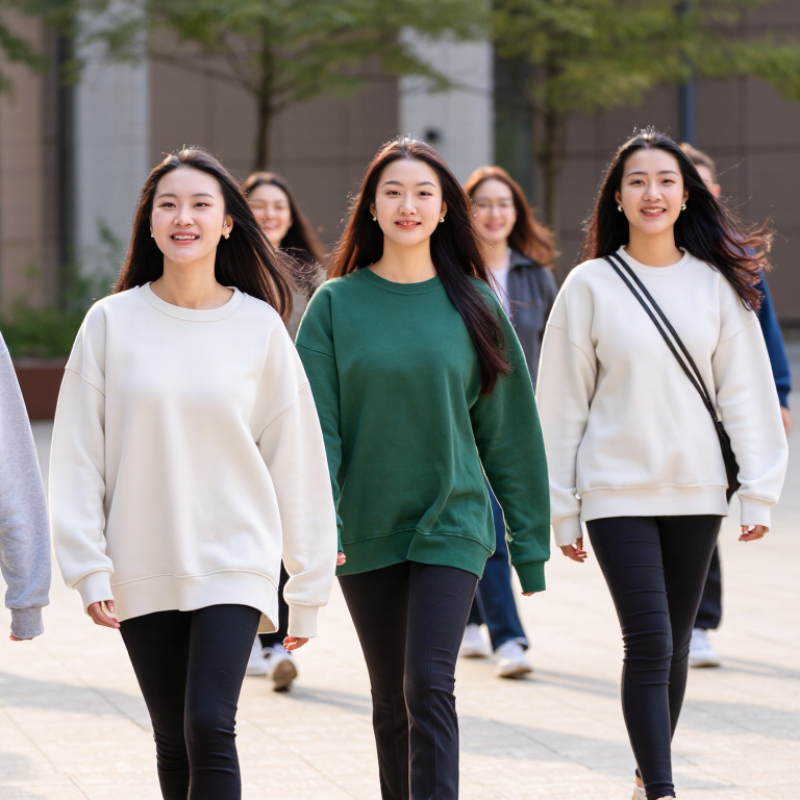
Oversized sweatshirts are defined by proportion, not simply by choosing a larger size. They usually feature dropped shoulder seams, a wider chest, fuller sleeves, and a longer body. Ribbed cuffs and hems control the extra volume. A relaxed neckline can add comfort, but too much fabric may look careless. The category remains imperfectly defined.
Fabric weight matters. Midweight cotton blends often support daily layering, while brushed fleece creates a warmer, softer hand feel. French terry offers a cleaner surface and better breathability.
Practical fitting checks include shoulder drop, sleeve stacking, and hem position. The cuff should reach the wrist without swallowing the hand. A useful test is simple: raise both arms and sit down. The sweatshirt should remain comfortable without excessive bunching.
Market data helps explain the interest, but it does not define the garment. Grand View Research estimated the global athleisure market at about 358.7 billion dollars in 2023, with projected annual growth of 9.3% from 2024 to 2030. This supports continued demand for relaxed clothing, though oversized sweatshirts are only one segment.
Textile Exchange reported that polyester represented roughly 59% of global fiber production in 2023. That figure raises a design question: softness and durability matter, but material impact cannot be ignored.
Oversized styling feels effortless. Sometimes, it is simply oversized.
Oversized sweatshirts did not appear overnight. Their roots reach back to early twentieth-century athletic clothing, when thicker cotton pullovers protected players from cold mornings and rough training. By the 1970s and 1980s, relaxed silhouettes moved beyond sports. Music, street culture, and youth communities made loose clothing feel expressive rather than careless. Bigger proportions also challenged formal dressing rules.
The 1990s strengthened this shift. Wide trousers, dropped shoulders, and layered knitwear made comfort visible in everyday outfits. Then, remote work and home-based routines accelerated the preference for soft, flexible clothing. Grand View Research valued the global athleisure market at approximately $358.9 billion in 2023. Its forecast suggests continued growth through 2030. That figure covers more than sweatshirts, but it shows the scale of comfort-led fashion.
The change is practical, too. A roomy sweatshirt allows movement, layering, and varied body shapes. McKinsey and The Business of Fashion’s State of Fashion 2024 report describes value, versatility, and comfort as major consumer concerns. Historical clothing research supports this direction, although market reports often simplify cultural change into numbers. That is a weakness worth noticing. Oversized fashion can feel inclusive, but extra volume does not automatically fit every body or climate. Fabric weight, sleeve length, and shoulder placement still matter. Small details decide whether relaxed looks feel intentional or merely unfinished.
What Is Driving the Trend of Oversized Sweatshirts?
Cultural and Social Forces Behind Their Growing Popularity
Oversized sweatshirts reflect a wider shift in how people define comfort and personal style. Clothing researchers often connect this preference with relaxed work routines and changing social spaces. Many people now move between home, cafés, classrooms, and shared offices. A loose sweatshirt fits each setting without demanding a complete outfit change.
Comfort is visible. Soft fabric, dropped shoulders, and generous sleeves can make the body feel less observed. This matters in a culture shaped by cameras, video calls, and constant social comparison. Some wearers also use oversized shapes to question narrow ideas about gender, size, and polished appearance. The garment becomes practical, but also quietly expressive.
Social media has strengthened the trend through everyday styling videos and street photography. Viewers see ordinary people layering sweatshirts with skirts, trousers, or athletic clothes. That variety makes the style feel accessible rather than exclusive. In my observation, younger consumers often value flexibility more than formal fashion rules. Still, the trend is not equally comfortable for everyone. Excess fabric can feel awkward, warm, or impractical on crowded transport. Oversized does not automatically mean inclusive. That assumption deserves more thought.
The style also reflects economic pressure. One roomy sweatshirt can support several outfits across seasons, which appeals to shoppers seeking longer use from clothing. Yet repeated buying for social approval can weaken that benefit. The contradiction remains visible: a garment associated with simplicity can still feed constant consumption.
The table connects the popularity of oversized sweatshirts with measurable social and cultural indicators. The figures provide context rather than claiming that any single factor directly caused the trend.
| Social or Cultural Driver | Measurable Indicator | Observed Data | Time and Geography | How It Supports the Trend | Evidence Strength | Source |
|---|---|---|---|---|---|---|
| Remote and hybrid work | Share of paid workdays performed from home | Approximately 27% | United States, 2024 average | More time spent at home and fewer formal workplace dress requirements increase demand for relaxed, easy-to-layer clothing such as oversized sweatshirts. | Strong context | WFH Research, Global Working from Home Survey |
| Casualization of everyday dress | Employees working from home on days they worked | 22.5% | United States, 2023 | The continued presence of home-based work shows that casual clothing is part of normal daily life rather than only a leisure or weekend choice. | Strong context | U.S. Bureau of Labor Statistics, American Time Use Survey |
| Comfort and low-effort dressing | Adults not meeting recommended physical-activity levels | 31% Approximately 1.8 billion adults |
Worldwide, 2022 | Although physical inactivity does not prove a clothing preference, the global need for comfortable, flexible garments helps explain why loose silhouettes are attractive for home, travel and light activity. | Indirect evidence | World Health Organization, Global Physical Activity Report |
| Youth-led digital culture | Teenagers who report being online almost constantly | 46% | United States, 2022 | High-frequency digital interaction accelerates the spread of visual style cues, including relaxed silhouettes, layered outfits and gender-neutral casualwear. | Moderate context | Pew Research Center, Teens, Social Media and Technology |
| Preference for versatile clothing | Adults reporting that they use clothing for multiple occasions | A widely documented consumer pattern | Observed across post-pandemic apparel research | Oversized sweatshirts can function as loungewear, casual outdoor clothing, travel clothing and a layering piece, giving consumers more outfit flexibility with one garment. | Qualitative evidence | The State of Fashion, consumer behavior analysis |
| Secondhand and circular-fashion awareness | Textiles disposed of in municipal solid waste | 17 million tons Generated in the United States in 2018 |
United States, 2018 | Growing awareness of textile waste encourages shoppers to favor durable, repeat-wear basics. Oversized sweatshirts are easy to layer, share, alter or wear across seasons. | Indirect evidence | U.S. Environmental Protection Agency, Textiles Material-Specific Data |
| Inclusive and less body-revealing styling | Growth of relaxed silhouettes in mainstream fashion coverage | Persistent trend since the 2020–2022 period | International fashion and lifestyle markets | Roomier garments can reduce fit pressure, support layering and accommodate a broader range of body shapes, making oversized styles appealing beyond a single age or gender group. | Qualitative evidence | Fashion and cultural commentary on oversized silhouettes |
| Economic pressure and wardrobe efficiency | Consumers seeking value, durability and repeat wear | A recurring post-inflation purchasing priority | International consumer markets, 2022–2024 | A simple sweatshirt can be worn repeatedly, layered across seasons and styled with different bottoms, helping consumers maximize the practical value of each purchase. | Moderate context | OECD, Consumer Prices and Inflation Indicators |
Note: The available public data usually measures work patterns, online behavior, physical activity, textile waste or consumer conditions rather than oversized sweatshirt purchases specifically. These indicators therefore show the broader forces that make oversized sweatshirts socially and practically attractive.
Oversized sweatshirts are gaining attention because comfort now shapes everyday clothing choices. Many people work, study, and travel in flexible environments. A loose sweatshirt supports movement without feeling restrictive. It also layers easily over a T-shirt or light shirt. In my experience, soft fabric and breathable construction matter more than extreme size. An oversized cut can feel relaxing, but poor proportions may look untidy and feel heavy.
Functionality also drives this trend. Roomier sleeves allow easier movement during commutes, errands, and casual outdoor activities. A deep pocket can hold keys, cards, or a phone. Ribbed cuffs help prevent sleeves from sliding over the hands. However, more fabric does not always mean better performance. Thick materials may become uncomfortable indoors or during mild exercise. This is where personal experience challenges the trend: comfort depends on climate, activity, and fit, not only appearance.
Tips: Choose a shoulder line that still looks intentional. Check whether the cuffs stay secure when you move. Select breathable fabric for warmer rooms. Pair a loose sweatshirt with straighter trousers for balance. Wash it according to the care label, because excessive heat can change its shape. Try sitting, reaching, and walking before deciding. Small checks matter.
Comfort, functionality, and changing lifestyle preferences are key factors behind the growing appeal of oversized sweatshirts.
The chart presents a comparative consumer-preference index from 0 to 100, showing the relative strength of major factors associated with oversized sweatshirt demand.
What Is Driving the Trend of Oversized Sweatshirts?
An oversized sweatshirt reflects more than comfort. It creates a soft outline around the body, especially with dropped shoulders and long sleeves. Media has made this shape visually familiar. Short videos show creators pairing large sweatshirts with cycling shorts, wide trousers, or bare legs. The look feels easy to copy. It also photographs well during quick, informal scrolling.
Contemporary streetwear adds stronger meaning. Loose silhouettes suggest movement, privacy, and resistance to strict dress codes. They work across classrooms, cafés, airports, and evening walks. Fashion companies respond because one roomy garment fits several styling habits. Euromonitor International’s 2024 apparel research identifies casualwear as a major driver of everyday clothing demand. Its findings support the shift from occasion dressing toward flexible, comfort-led wardrobes. Still, oversized does not automatically mean stylish. Proportion matters.
Economic pressure also influences the choice. The State of Fashion 2025 report, published by McKinsey and The Business of Fashion, describes value-conscious consumers as a continuing market force. A durable sweatshirt can replace several lighter layers. ThredUp’s 2024 Resale Report projects the global secondhand apparel market will reach 350 billion dollars by 2028. That forecast makes longevity more important, even for trend-led pieces. However, the argument has a weak point. Oversized clothing may use more fabric, and poor-quality fleece can lose shape quickly. I have seen sleeves cover the hands after only a few washes. That detail is easy to ignore online. Real wear eventually exposes the difference between visual volume and thoughtful design.
Their roots reach early athletic clothing. Loose shapes spread through music, street culture, and youth communities during the 1970s and 1980s.
They allow movement, layering, and comfortable daily wear. Soft fabric can feel useful during travel, study, or quiet evenings.
Wide trousers, dropped shoulders, and layered knitwear made comfort visible. Everyday outfits became less formal and more expressive.
Short videos make oversized outfits easy to copy. Large sweatshirts also photograph clearly during quick scrolling.
Not automatically. Sleeve length, shoulder placement, and fabric weight still affect comfort and balance.
Pair it with wide trousers, fitted shorts, or simple layers. Showing a small area of the lower body can create contrast.
No. Proportion matters. A sweatshirt with sleeves covering the hands may look careless after repeated washing.
Yes, one durable piece can replace several lighter layers. That benefit weakens when fleece loses shape quickly.
Not necessarily. Extra fabric may raise costs, and low-quality materials can wear out sooner than expected.
Check the shoulder seam, sleeve reach, fabric weight, and recovery after stretching. Online photos can hide important flaws.
Oversized sweatshirts are defined by their loose silhouettes, dropped shoulders, roomy sleeves, and soft fabrics that create a relaxed yet expressive look. Their popularity reflects the long-term shift from structured, restrictive clothing toward casual and oversized fashion. Once associated mainly with leisurewear, these sweatshirts have become adaptable pieces that can be styled for everyday activities, social settings, and creative self-expression.
So, why are oversized sweatshirts trending right now? Their appeal comes from a combination of comfort, practicality, and changing lifestyles. Flexible work routines, increased focus on well-being, and a preference for easy layering have made relaxed clothing more attractive. At the same time, media, online communities, and contemporary streetwear culture have helped normalize generous proportions as fashionable rather than careless. Oversized sweatshirts also allow people to communicate individuality through color, texture, fit, and styling, making them both functional wardrobe essentials and symbols of modern casual culture.

Eglin Fashion